Thursday, 12 May 2016

Latest Journal Article: ‘Representations of the family in postwar British amateur film: family histories in the Lane and Scrutton collection at the East Anglian Film Archive’, in The History of the Family journal


Here is an overview of my latest journal article for those interested in:
  • home movies

  • representations of the family

  • leisure

  • postwar social history

  • national identity

ABSTRACT
This article examines the construction of the postwar British family in amateur film with reference to
the Sidney Lane and Cecil Scrutton collection held at the East Anglian Film Archive (EAFA), particularly the films covering 1948 – 1961.
Heather Norris Nicholson argues that home movies contribute to ‘an understanding of leisure and visual- related practices of consumption as well as the social processes by which people came
to give themselves, and others, identities’ in the mid-twentieth century (Nicholson, H. N. [2004]. At Home and Abroad with Cine Enthusiasts: Regional Amateur Filmmaking and Visualizing the Mediterranean, ca. 1928 – 1962’. Geojournal,
49, 323–333).
By considering the social and historical contexts in which these home movies were produced, and using accompanying notes by one of the filmmaker’s sons, the leisure time films of
Lane and Scrutton can be analysed in order to understand how the amateur cine hobby ideologically constructed family, community and national identity in postwar Britain.
The images of Christmas parties, daytrips and holidays in these films reveal much about this particular family, and are therefore very illuminating to the social historian and film scholar of
today.


My journal article is based on some research I carried out at the East Anglian Film Archive a couple of years ago. Whilst there I viewed the birthday parties, day trips and holidays that the Lanes and Scruttons had filmed in Norfolk and other parts of Britain. I also got to know the family’s history in the 1950s, due to the collection’s reminiscences recorded in a document by one of the filmmakers’ sons.

Family collections such as this provide a fascinating insight into social history, and also how people
represented their leisure activities in amateur film: The cine hobby itself being a leisure pastime – popular with families who could afford it – in the postwar period.


Wednesday, 30 September 2015

Why I Reckon Whitby Folk Week is Like Butlin's, Circa 1946


Whitby Folk Week is like a folkies' take on the old fashioned holiday camps.

This is meant in good fun and it may seem controversial to most lovers of folk music and dance(!), but on my first ever visit to Whitby Folk Week this August I couldn't help seeing the comparisons with J.A.R Pimlott's visit to Butlin's at Clacton in 1946.
Part of the schedule Pimlott noted in 1946

With so many activities and entertainments on throughout the week, everything has to be kept to a tight schedule. After purchasing my programme I was able to browse carefully through the itinerary and get an idea of what was on. It was then that the comparison with Butlin's struck me.

Part of the Whitby Folk Week programme
Butlin's 1946: 10am Games and Exercises.

Whitby 2015: 10am Dance workshop.


I took part in a few Longsword workshops. Not a style of dance I'm used to, so it was refreshing to not only get some exercise, but also to focus on learning something new for 90 minutes in the morning.

Butlin's 1946: 11.15am Kiddies' fun.
Whitby 2015: 10am Playtime for children.

Butlin's 1946: 8.30pm Campers' concert.
Whitby 2015: 8pm Concert / or Marathon singaround.

Butlin's 1946: 9pm Ballroom dancing.
Whitby 2015: Evening ceilidhs.

Some of the latter are 'themed' at Whitby Folk Week and fancy dress is encouraged, adding to the raucous seaside atmosphere. This years theme was 'gold'.


Visitors to the Gold Ceilidh
Butlin's 1946: Knobbly Knees contest.

Whitby 2015: A close competition between some of the North West and rapper teams in 2015!

Newcastle Kingsmen
The location by the North Yorkshire coast also gives festival goers the opportunity for time out to take a paddle, a moorland walk (not unlike the organised amble at Butlin's in 1946), and to take part in the cultural practices of the British seaside, such as eating ice creams and fish and chips.

One of the teams pretended to be on a roller coaster ride during the parade
The Whitby hotel, Rosa, has the Butlin's motto hanging in the cafe (also a Shakespeare quote!)
On the Thursday there was an hilariously lighthearted North West dance contest in which four teams competed to raise their knees the highest, dance in straight lines and race a relay, wolfing down a pork pie between runs. The winning side (the Newcastle Kingsmen) won a golden clog for their efforts and performed a victory dance for the watching crowds. It was pure holiday camp. 

Here's a link to a video of the North West Contest

Further reading:

Pimlott, J.A.R (1975 reprint), The Englishman's Seaside.

Atkinson, Sally, (2015) Whitby Folk Week, 50 Years and Counting.

Monday, 14 September 2015

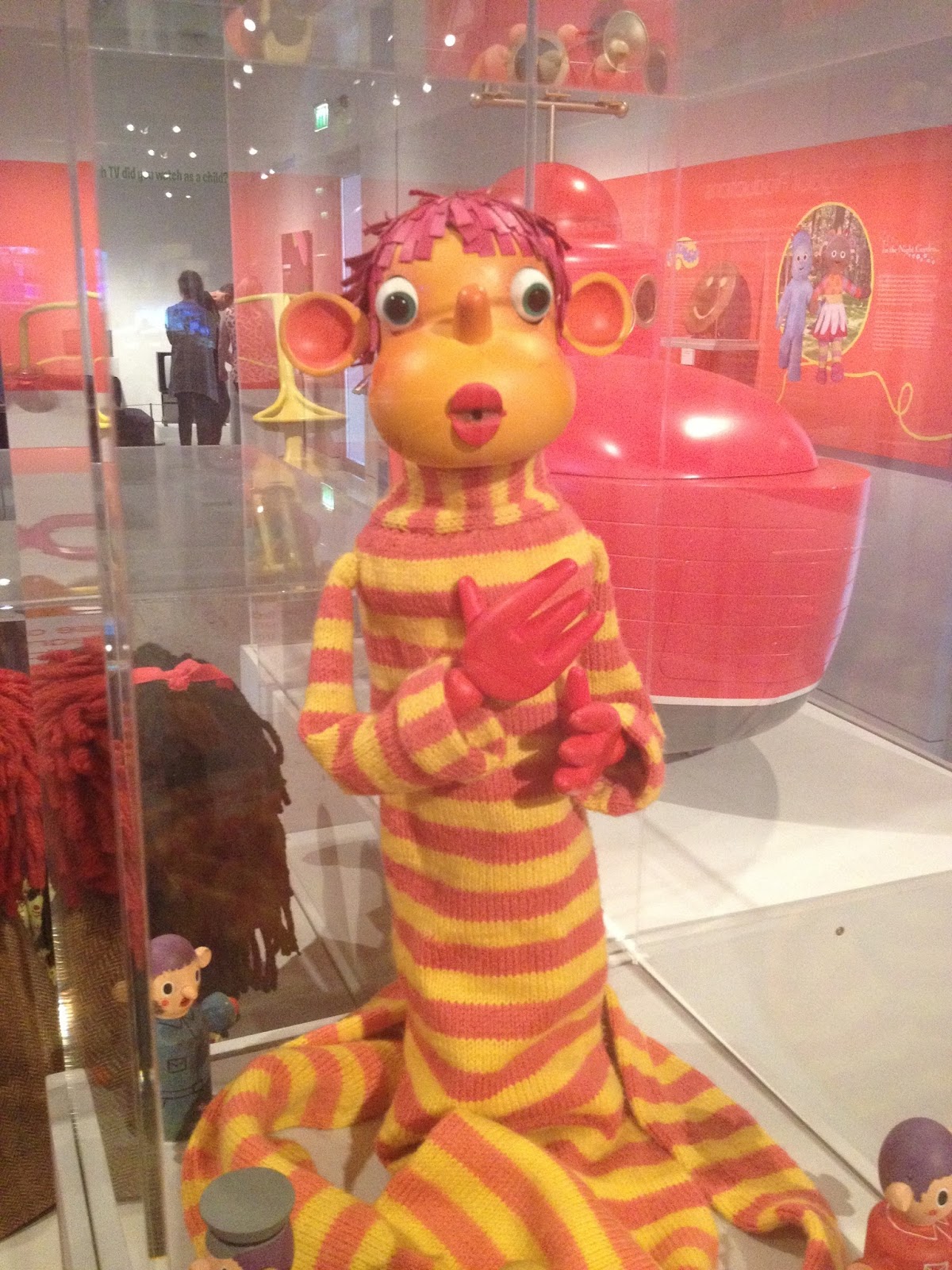
The Story of Children's Television Exhibition


Mr Spoon from Button Moon


This Summer I visited 'The Story of Children's Television' exhibition at The Herbert museum in Coventry.

A nostalgia trip for most of the adults attending, this exhibition covers the years 1946 to the present, and will hopefully tour the UK after September for other people to appreciate. Here are some of the exhibits I enjoyed:


One of the Wooden Tops


Little Ted and Humpty from Playschool - the latter designed by Kristin Baybars,
a  woman I've met, and whom I greatly admire


Finger Mouse from Finger Bobs


A cat, which I did not recognise, from before my time


Lenny the Lion toy

Ali Cat being un-PC and performing with a cigarette on one of the video screens!


A selection of 1980s toys


Battle Cat from Masters of the Universe


Familiar faces from Dramarama

Gordon the Gopher wearing a jacket that Adam Ant had given to him


Pob - the puppet who used to controversially spit at the TV camera, then wipe it off

One irresistible attraction was to dress up as a favourite character and appear behind a giant TV screen...


Sunday, 6 September 2015

Hammer Archive, Demontfort University


The Hammer Archive at DMU provides a great insight into the life of many of the Hammer films via the development of their scripts. Not only are there a treasure of unrealised projects housed on the archive shelves, but a quick glance through some of the screenplays here reveals how scripts can change when films go into production.


For example, I had a look at the script for Holiday on the Buses (1973) and found that the final scene in which Stan Butler finds employment on a demolition site was originally to show him laying tarmac on a road.


Whilst there I also had a look at screenplays for Straight on Till Morning (1972), Demons of the Mind (1972) and an unmade gem I forget the name of, but it came across as a terrible misfire somewhere between Tom Jones (1963) and Carry on Dick (1975). Wish I could remember what it was called, (perhaps it was The Haunting of Toby Jugg) but maybe it will feature as part of a proposed script reading / recording that Dr Matt Jones of DMU mentioned to me.


The archive which mostly consists of screenplays (at various stages of the films' production including shooting scripts) plus some publicity material, is open for public access dependent on staff availability and the academic timetable. It is certainly a great resource for all horror buffs and British film researchers.


Thursday, 13 November 2014

David McGillivray introduces House of Mortal Sin 8/11/14


My first experience of a Pete Walker film was catching the final 5 minutes of The Comeback (1978) on late night TV in the 1980s. A screening of House of Whipcord (1974) at a two-day film festival of 1970s trash at the Phoenix, Leicester in the 1990s cemented my addiction.

It was at the Phoenix festival that screenplay writer for Whipcord, David McGillivray autographed his Doing Rude Things book and dedicated it to the 'Twins of Evil' (my brother and I) simultaneously dismissing his own joke as "the usual rubbish".

McGillivray wrote a wonderfully economic script for Pete Walker's House of Mortal Sin (1976) that is both chilling and hilarious. However, he claims not to have seen the film since the cast and crew screening, so embarrassed is he by his work.

McGillivray has an eternally dry wit and self-deprecating sense of humour that is immense fun for the listener. Here he is introducing House of Mortal Sin at the Barbican, London, with Kim Newman, on 8th November 2014 (audio with stills):


Tuesday, 11 November 2014

Abstract: The Changing Face of the Amateur Holiday Film in Britain as Constructed by Postwar Amateur Cine World (1945-1951)


This is a copy of my abstract from an article I recently had published in the Historical Journal of Film Radio and Television.

The Changing Face of the Amateur Holiday Film in Britain as Constructed by Postwar Amateur Cine World (1945-1951)

Amateur film-making, motoring and holidaymaking were three complementary leisure activities that re-emerged with a greater intensity for middle-class consumers in Britain in the immediate post-war period. The end of restrictions on travel, an increasing availability of film stock and the first real chance to take advantage of the Holidays With Pay Act (the latter of which had been disrupted by the Second World War) created new opportunities for cine enthusiasts to produce a holiday film after 1945.

In this article, I consider how instructional articles on how to make a holiday film may have helped to construct ideologically a sense of British national identity for the middle-class readers of Amateur Cine World between 1945 and 1951. These articles can be mapped closely with the shifting patterns of holiday- making in the post-war period, and tend to encourage cine hobbyists to construct a sense of Britishness through their representations of the holiday; initially through images of the British countryside and coastline, and eventually by the framing of cultural difference in their first holidays abroad. 

A close analysis of this discourse can provide an insight into a construction of class, gender and national identity that is an alternative to the mainstream British feature film, for instance. 

The full article can be found online at:
Matt's Article at Taylor Francis Online


Tuesday, 25 June 2013

The Beauty Jungle (1964)


The Beauty Jungle (1964) is a welcome release to DVD, having been unavailable for many years – I only managed to see the film several years ago as a BFI viewing copy, despatched to the midlands in a pile of film cans.

The film offers a critique of beauty contests (as the DVD cover says, the film is an ‘inside story of the beauty racket’), and reveals the cynicism at the heart of the modelling industry, which glorifies women whilst simultaneously commodifying them. This can be seen in the montage of crass, regionally sponsored competitions such as ‘Cheltenham’s Miss Banana Yoghurt’, ‘Miss Devonshire Cream’ and ‘Pontypool’s Crumpet Queen’, and also in Monte Carlo’s grotesque circus promoting ‘Le Parfum Miss Trapeze’, in which clowns tickle the bikini-clad women with feather dusters in a nightmarish scene. The film offers a cautionary tale that the life of the international jet-set is not necessarily one to which ‘decent’ British girls like the heroine Shirley Freeman (Janette Scott) should aspire. As Shirley says at the film’s conclusion, “You take someone from nowhere, you give her something, and then, when the party’s over, you say ‘you’ve lost, go home’.”

Christine Geraghty argues that compared to the beginning of the postwar period – when cinema could be considered as the ‘entertainment for all’ – by the end of the 1950s it had largely become a ‘marginal pursuit’, with producers endeavouring to find niche markets such as youth audiences, or by presenting big-budgeted must-see, event films (Geraghty, 2000: 20). One of the ways in which British film attempted to broaden its audience in the latter postwar period was by striving for international appeal, or by working with American companies which could offer film distribution in the US. In 1956, for example, the Rank Organisation announced a policy of only producing films which would appeal to international markets and consequently established Rank Film Distributors of America (RFDA) in order to ‘penetrate the US market’ (Murphy, 2001: 90).

Although (in film terms) ‘international’ often refers to part-funding by an American film company, it could also be used to describe a feeling of internationalism conveyed for the most part by including overseas locations, international cast members, and ‘American’ technological advances such as Technicolor, CinemaScope and VistaVision. These technical innovations – which were largely a response to the encroaching dominance of television – arguably favour location filming, as the emphasised artificiality of studio-bound, widescreen Hollywood musicals such as Brigadoon (1954) and the ‘Barn-Raising Ballet’ in Seven Brides for Seven Brothers (1954) reveal. In opposition to this, the location filming in Summer Holiday (1963) and The Beauty Jungle, for example, works to the films’ advantage, in offering a ‘tourist gaze’ of Europe (Urry, 2002).

The Beauty Jungle (Renamed Contest Girl for its American release) bridges a wide gap between the traditional British seaside holiday of the immediate postwar era, and the exotic, foreign holiday seen in Summer Holiday, for instance. Starting in the seaside town of Weston-Super-Mare, and taking Shirley Freeman on a journey from the beauty contests of Butlin’s to an international modelling career, this colourful, CinemaScope film represents the spectacle of the Riviera and Mediterranean which the rich and famous flocked to in the late 1950s and early 1960s in order to gain that longed-for tan.


The film follows the postwar trait of fleshing out its cast with numerous ‘guest stars’, including Norman Hartnell (“the man who dresses the greatest beauties in the world”), the Duchess of Bedford, Stirling Moss, Hollywood actress Linda Christian, and musician Joe Brown (representing the teenage market) as contest judges. The British actor Edmund Purdom who had made a name for himself in American and European films also appears as the Hollywood star Rex Garrick (he was the husband of Linda Christian when the film was made).

The Beauty Jungle treats the cinema audience to ‘tourist gaze’ shots of Nice, Cannes and Monte Carlo, where Shirley and her manager, Don Mackenzie (Ian Hendry), ostentatiously arrive in a ‘heli-taxi’ for the ‘Miss Globe’ contest. The numerous contestants for this competition bring an international flavour to the film, coming from places as far afield as Peru, France, Germany, America and Japan.

The film clearly follows neither the styles of Social Realism nor Swinging London, which had put the British film industry on the international map in recent years (despite these styles being arguably more indigenous and domestic in feel), and appears too naïve and gauche to really make an impact as an exposé of the glamour industry. In the film’s efforts to appeal to both British and international markets, and to critique the modelling industry whilst at the same time entertain the audience with glamorous spectacle, the end result is something of a curiosity, and invites repeated viewings. It is a pity therefore that the DVD transfer is in a 4:3 pan-and-scan version, and that a lot of the potential spectacle and subsequent viewing pleasure has been lost (a quick look at the customer reviews on Amazon.co.uk will give you a clue). In an age where widescreen television is the norm rather than the exception, the DVD is already dated, not by the film content – which as a mid-60s curio still has the ability to entertain – but by the more recent home viewing technology.

Here are the opening credits (in CinemaScope!):

Bibliography:
Geraghty, Christine, 2000, British Cinema in the Fifties, Gender, Genre and the ‘New Look’, London: Routledge

Murphy, Robert (ed.), 2001, British Cinema of the 90s, London: BFI

Murphy, Robert, 1992, Sixties British Cinema, London: BFI

Urry, John, 2002, The Tourist Gaze, (Revised edition), London: Sage Publications