Showing posts with label Nottinghamshire. Show all posts

Monday, 8 July 2019

Carry On Glamping (My Radio Interview about the Carry Ons)


I contributed to a BBC radio Nottingham broadcast that took place from Meadow View Glamping and Leisure, Stapleford, Nottingham.

My reason for being there was that they wanted someone to talk about the fiftieth anniversary of the release of Carry On Camping (1969)! It came as a bit of a shock to realise that the film is fifty years old. It suddenly brought home how often and how long I have been watching this film. I recall a classmate talking about the mother-in-law being chased by a ram in the final scene the day after the film had been shown on TV. (Which might possibly have been its first TV broadcast).

Although I mention Carry On Camping in my book The Holiday and British Film (2012), I devote a bit more space to the caravan-site-themed Carry On Behind (1975). This is mainly because the chapter it appears in is loosely focused on caravan holidays, but also because I wanted to highlight Behind as it isn’t so often discussed as much as Camping.

Back to the film itself in a bit. What was most startling about my recent experience was seeing how radio is produced these days. I turned up at the glamping site to meet the presenter (Mark Dennison) and two other members of the team.

They had got into the camping spirit! Between the three of them they had slept in one of the luxurious glamping pods; a modern pop-up style tent; and an old-fashioned scouting tent with metal poles.

Everything about the way the programme was produced was deceptively casual. The presenter was holding an iPad / tablet and a microphone, and was wearing a set of headphones. A clipboard with a few notes was close to hand.


Although he could hear the programme being broadcast (music, news reports, and so on...) neither myself nor the rest of the production team could. Occasionally the presenter would chat to the rest of the team - “we’ve got ten minutes till the news, we could have another record before then...” or suddenly go into radio mode and laugh and comment on something he had heard through his headphones that we weren’t party to.

It was impressive to see how slickly the whole thing was handled. To look so laid back but to be in total control of a live radio broadcast, sitting in a chair on the edge of a field in Stapleford was an eye-opener. It also proved that studios are almost a thing of the past.

As I waited for my turn I went over a few points in my head. Then the presenter started chuckling at a sound clip from Carry On Camping that the rest of us couldn’t hear. Suddenly a few words and the microphone was thrust under me. Here are a few things that we discussed in the interview:

Would the Carry Ons work today if new versions were released? 


Probably not. Although some fans (including myself) love the films on a nostalgic level - with a tinge of guilty pleasure - much of the humour the series is based on would appear very out of context today. It would be difficult to deal in such humour without offending a large proportion of people. Thinking nostalgically, I distinctly recall kids at school playing Odd Bod and Junior in the school playground after watching Carry On Screaming (1966). The radio presenter pointed out here that there were aspects of the films that kids could enjoy as well as adults.

I spoke about how it was quite incredible that a feature film had been produced mainly around the location of a muddy field, and that no British film would ever get away with that nowadays without criticism for being cheap.

I did also say that Carry On Camping is my favourite of the series. Probably due to its simplicity and the fact that after seeing it so many times I can predict the lines that are coming up. I spoke about seeing it at the old Phoenix Arts cinema in Leicester in the 1990s as part of the annual comedy festival and how the audience applauded at the film's conclusion. This is not the only time I’ve witnessed this in the cinema, but it is a very rare occurrence.


After about seven minutes the interview was over. It was the turn of the campsite owner to be interviewed. In his interview he said that opening the site was part of a move to make Stapleford an up-and-coming area.


What an experience - to witness this first-hand, and to see how radio is produced these days.


Monday, 21 August 2017

Two National Trust Houses: Mr Straw's House and Stoneywell Cottage


These two National Trust Houses in the East Midlands are both worth a visit. They invite an interesting contrast!

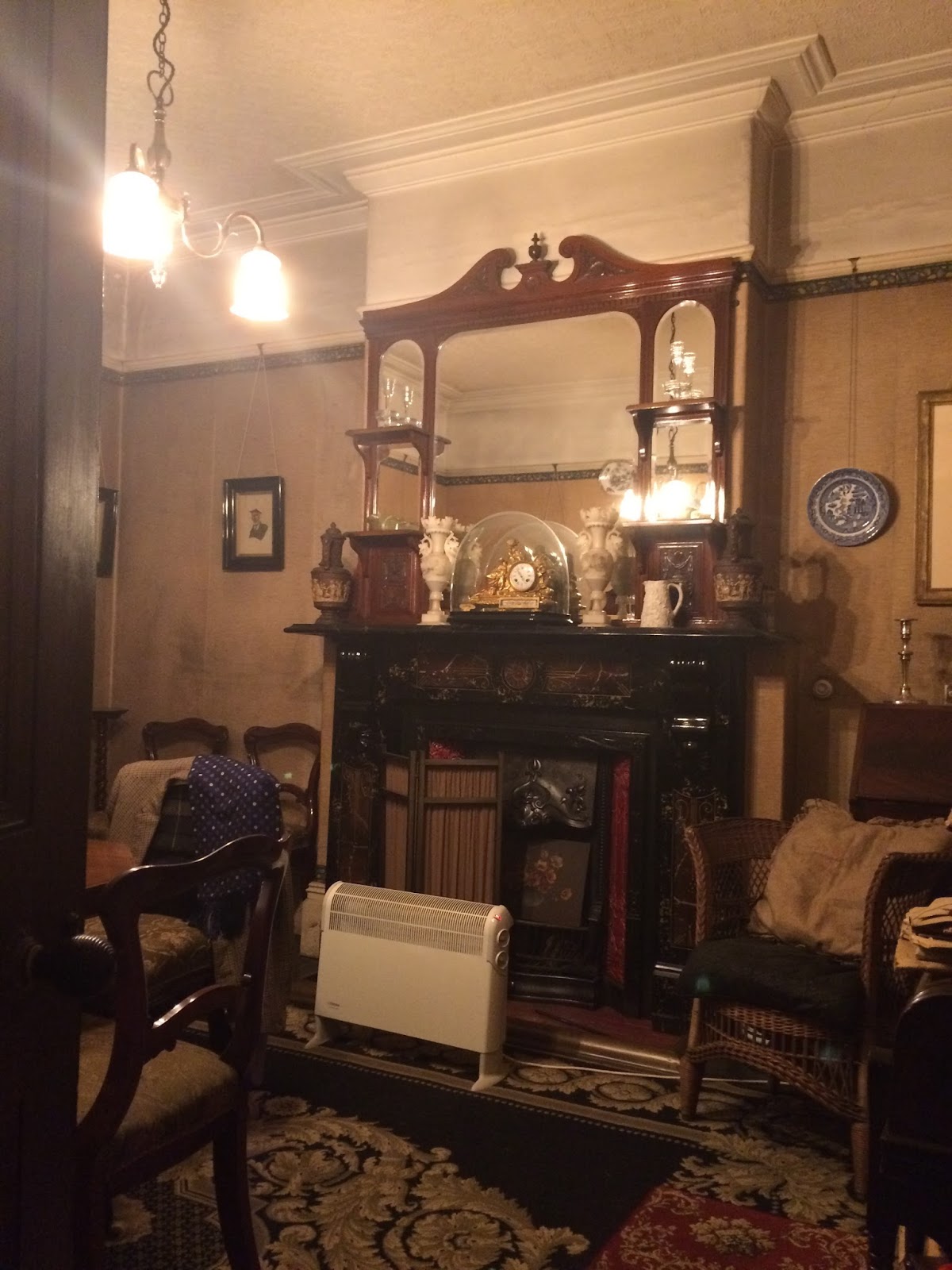
Mr Straws House was left to the National Trust in 1990 when William, the last member of the Straw family, passed away at the age of 92.


No.7 Blyth Grove in Worksop is a semi-detached house built circa 1905. It is a relatively large house befitting a well-to-do family that made its money from a grocers shop. The Straw family moved into the house in the early 1920s. The house and contents remained largely untouched from 1932 when William senior, the father of the house died suddenly whilst gardening. His wife Florence died seven years later.


Although fascinating, there is something decidedly stifling about this abode that has been stuck in a timewarp since the 1930s. Even the calendar in the dining room still reads 1932, and William Straw Snr’s pipes and tobacco pouch are still hanging up there.


Everything is decorated in browns, and piles of hoarded letters and papers are stacked around the piano in the drawing room. The parents’ bedroom has layers of clothes preserved between the bedclothes and the bed has been laid over with newspapers to preserve its contents.


*****

An altogether different experience awaits those who visit Stoneywell House in Charnwood, Leicestershire.

Although the road past Stoneywell is very familiar to me, any passer by would be completely unaware that the large stone house is hidden behind a dip in a hill a short walk from the roadside.


Built at the end of the 19th century, Stoneywell is in the Arts and Crafts style, and being constructed of local stone, it is meant to give the impression of growing naturally out of the landscape. It originally had a thatched roof that was destroyed by a fire. However, the local slate helps the appearance of the house to blend in with the surrounding countryside. (Slate from nearby Swithland is characteristic of the Charnwood area). 

One of the quirky delights of this house is that you can exit an upstairs bedroom window and step onto the ground outside without injury, because the house is built on a slope.


the bedroom window


The home belonged to Leicestershire industrialists, the Gimson family, and was designed by architect Ernest Gimson as a summer residence. The interior is light, airy, and uncluttered. It reminded me a lot of Kettle’s Yard in Cambridge with its muted and calming colour palette of natural wood and white walls. One of the rooms even has an Orkney Chair like the one at Kettle’s Yard.


Orkney Chair (to the right) in the sitting room


The grounds are also very beautiful, retaining the natural look of the Charnwood landscape with its granite rocks, ferns, and surrounding woodland.


If you want to visit either house, you will need to book a tour. Stoneywell is approached by a mini bus that carries you from a nearby car park.


Further reading: Mr Straw’s House, 1993 (reprinted 2011), National Trust

Chesters Thompson, Simon, and Groves, Anna, 2015, Stoneywell Cottage, National Trust


Thursday, 26 April 2012

The Film Star Dolls of Vina Cooke


Note: Sadly, since I posted this blog in Spring 2012 the doll museum has closed and the premises are for sale. If I find out any more details about what has happened to Vina's collection, I'll post it here.

In a quiet corner of Nottinghamshire you'll find an almost-secret treasure. This is the Vina Cooke Museum of Dolls in the village of Cromwell... A staggering collection of dolls, dolls houses, and antique fashions housed in a grand Georgian house. Vina and her husband have spent several decades putting this collection together. Some might call it an exercise in British eccentricity, others will call it a labour of love.

The most interesting items are the pieces created by Vina herself. These aren't dolls per se, but reproductions of historical figures and film stars dressed in fantastic miniature costumes. Henry VIII and his wives, and Dame Margot Fonteyn and Rudolf Nureyev are some examples. 

Dorothy, Tin Man and Scarecrow modelled from The Wizard of Oz (1939)
The Cowardly Lion looks just like Bert Lahr!

 Film buffs however, will be drawn to the display cabinets housing Hollywood stars in authentic reproductions of costumes by the likes of Irene Sharaff (Liz Taylor in The Taming Of The Shrew 1967) and Cecil Beaton (Audrey Hepburn in My Fair Lady 1964). Cooke is particularly good at painting eyes - Bert Lahr is very accurate! - and  the way she has captured the movement of Brigitte Bardot dancing is also very good. 

Elizabeth Taylor in The Taming of the Shrew (1967)
A selection of film star dolls can be found in this room including Brigitte Bardot and Yul Brynner.

Cromwell is a short drive or bus ride away from Newark, so I recommend a quick excursion to see the dolls if you are in the area, but phone first to check for opening times. There's also a doll repair service available if diddum's is falling apart!

Tel: UK 01636 821364 


British Pathe film of Vina and her film star dolls


http://www.aboutbritain.com/VinaCookeMuseumOfDolls.htm
 
http://www.vinasdolls.co.uk/