

These two
National Trust Houses in the East Midlands are both worth a visit. They invite
an interesting contrast!
Mr Straws House
was left to the National Trust in 1990 when William, the last member of the
Straw family, passed away at the age of 92.


No.7 Blyth Grove
in Worksop is a semi-detached house built circa 1905. It is a relatively large
house befitting a well-to-do family that made its money from a grocers shop.
The Straw family moved into the house in the early 1920s. The house and
contents remained largely untouched from 1932 when William senior, the father
of the house died suddenly whilst gardening. His wife Florence died seven years
later.

Although
fascinating, there is something decidedly stifling about this abode that has
been stuck in a timewarp since the 1930s. Even the calendar in the dining room
still reads 1932, and William Straw Snr’s pipes and tobacco pouch are still
hanging up there.
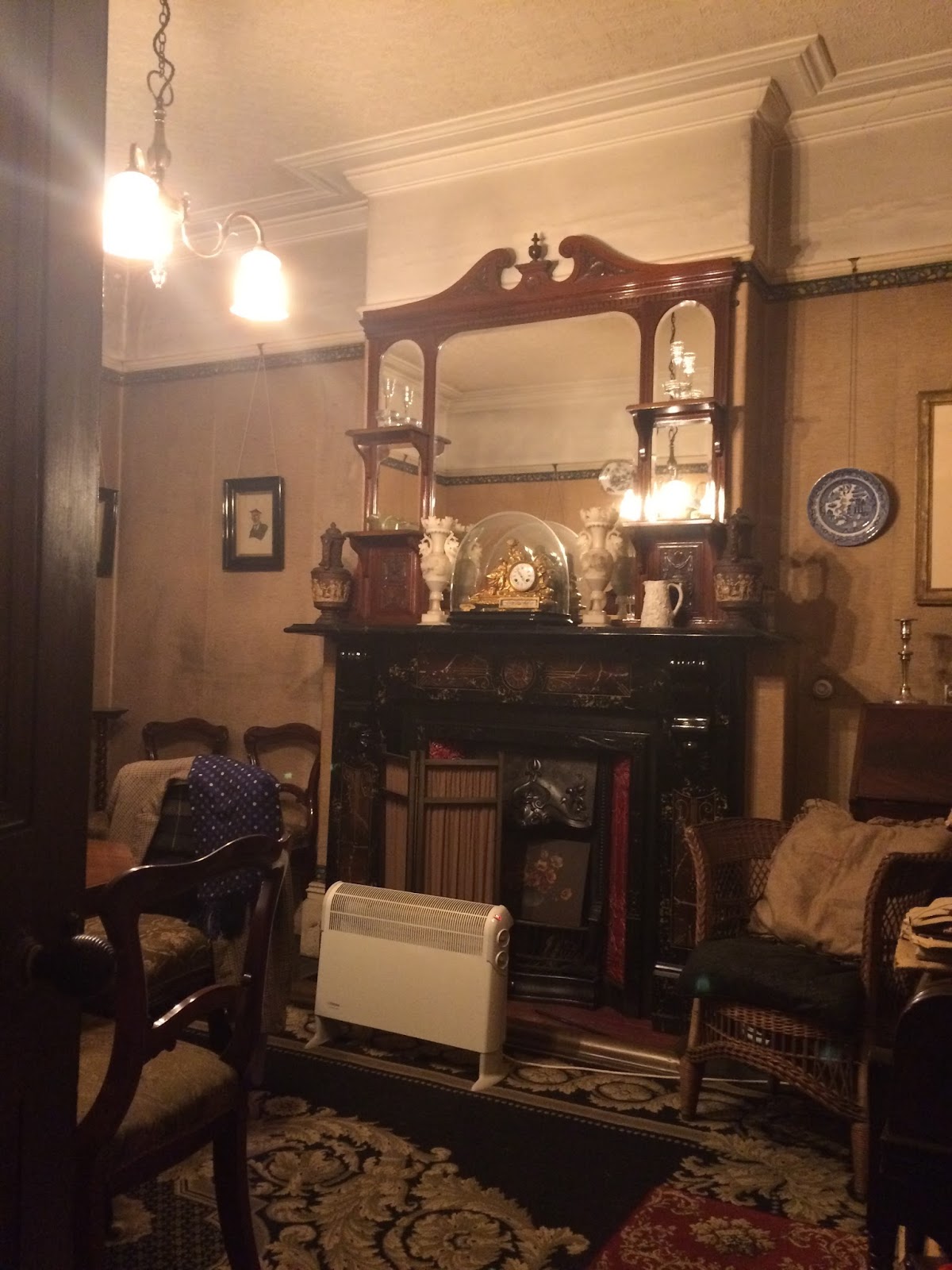


Everything is decorated
in browns, and piles of hoarded letters and papers are stacked around the piano
in the drawing room. The parents’ bedroom has layers of clothes preserved
between the bedclothes and the bed has been laid over with newspapers to preserve its contents.


*****
An altogether
different experience awaits those who visit Stoneywell House in Charnwood,
Leicestershire.
Although the road
past Stoneywell is very familiar to me, any passer by would be completely
unaware that the large stone house is hidden behind a dip in a hill a short
walk from the roadside.


Built at the end of the 19th century, Stoneywell is in the Arts and Crafts style, and being constructed of local stone, it is meant to give the impression of growing naturally out of the landscape. It originally had a thatched roof that was destroyed by a fire. However, the local slate helps the appearance of the house to blend in with the surrounding countryside. (Slate from nearby Swithland is characteristic of the Charnwood area).
One of the quirky delights of this house is that you can exit an upstairs bedroom window and step onto the ground outside without injury, because the house is built on a slope.
One of the quirky delights of this house is that you can exit an upstairs bedroom window and step onto the ground outside without injury, because the house is built on a slope.

 |
| the bedroom window |

The home belonged
to Leicestershire industrialists, the Gimson family, and was designed by architect
Ernest Gimson as a summer residence. The interior is light, airy, and
uncluttered. It reminded me a lot of Kettle’s Yard in Cambridge with its muted
and calming colour palette of natural wood and white walls. One of the rooms
even has an Orkney Chair like the one at Kettle’s Yard.


 |
| Orkney Chair (to the right) in the sitting room |


The grounds are
also very beautiful, retaining the natural look of the Charnwood landscape with
its granite rocks, ferns, and surrounding woodland.


If you want to
visit either house, you will need to book a tour. Stoneywell is approached by a
mini bus that carries you from a nearby car park.
Further reading: Mr Straw’s House, 1993 (reprinted 2011),
National Trust
Chesters Thompson, Simon, and Groves, Anna, 2015, Stoneywell Cottage, National Trust
Chesters Thompson, Simon, and Groves, Anna, 2015, Stoneywell Cottage, National Trust


