Sunday, 28 July 2019

A Visit to Two Charles Rennie Mackintosh Houses


This year I visited two houses designed by Charles Rennie Mackintosh. Both distinct experiences.


78 Derngate is the only house in England designed by Mackintosh. It is well worth booking in advance for a tour, as you will get to hear some interesting historical details about the house. You will also be shown photographs of the house as it was many years ago, and compare these with how the house has been sympathetically restored today.

Before entering, visitors are asked to wear plastic overshoes – as if going in to perform a forensic examination. Once inside, you are allowed to move around the rooms freely, without touching anything.


This townhouse is designed to feel uncluttered even though it is remarkably narrow. Rooms are stacked on top of each other on several floors in more or less this fashion: one room at the front, one at the back, with staircase between.


The 1916 designs – particularly of the front ground floor room and the guest bedroom – still appear modern by today’s tastes over one hundred years after they were designed.


Later in the year I visited The Hill House. Built in 1902-3, with further additions of Mackintosh-designed furniture over the next ten years, I had wanted to see this house for a very long time. When I had the opportunity to visit, I was surprised to find out that it was shortly to reopen with a new conservation project/visitor attraction called ‘The Box’. Upon close inspection, you will see that the walls of the Box are a screen of steel mesh (like chain mail). Originally, visitors would have been able to experience the sight of Hill House against the Scottish landscape, but it looks likely that this view will be denied for approximately ten years while the damp house dries out naturally, shielded from the Scottish rain.


Although denied this view, another experience has taken its place. There are walk ways around and over the roof of the house, so that visitors can see the architecture from several vantages. I thought perhaps, that the Box would spoil the visit to Hill House, making it more of a gimmick. But I was not disappointed. Turning the conservation work into an attraction itself has been advantageous because it gives visitors such a unique opportunity to enjoy the house on many different levels (literally as well as figuratively).


Once inside, it is easy to ignore – nay forget – that the Box is situated outside, and therefore the steel structure in no way affects the experience of walking through the beautiful Mackintosh rooms. 


I walked around the house a couple of times and overheard another visitor say “I don’t want to leave”.

Who would?


Incidentally, items from the Hill House are sometimes loaned out to the Kelvingrove Art Gallery and Museum. This was the case on my visit. So I visited the latter to see Mackintosh's Kimono writing desk. Another beautiful item, and easy to envisage standing in the drawing room of Hill House on the opposite side of the fireplace to the settle.


Monday, 8 July 2019

Carry On Glamping (My Radio Interview about the Carry Ons)


I contributed to a BBC radio Nottingham broadcast that took place from Meadow View Glamping and Leisure, Stapleford, Nottingham.

My reason for being there was that they wanted someone to talk about the fiftieth anniversary of the release of Carry On Camping (1969)! It came as a bit of a shock to realise that the film is fifty years old. It suddenly brought home how often and how long I have been watching this film. I recall a classmate talking about the mother-in-law being chased by a ram in the final scene the day after the film had been shown on TV. (Which might possibly have been its first TV broadcast).

Although I mention Carry On Camping in my book The Holiday and British Film (2012), I devote a bit more space to the caravan-site-themed Carry On Behind (1975). This is mainly because the chapter it appears in is loosely focused on caravan holidays, but also because I wanted to highlight Behind as it isn’t so often discussed as much as Camping.

Back to the film itself in a bit. What was most startling about my recent experience was seeing how radio is produced these days. I turned up at the glamping site to meet the presenter (Mark Dennison) and two other members of the team.

They had got into the camping spirit! Between the three of them they had slept in one of the luxurious glamping pods; a modern pop-up style tent; and an old-fashioned scouting tent with metal poles.

Everything about the way the programme was produced was deceptively casual. The presenter was holding an iPad / tablet and a microphone, and was wearing a set of headphones. A clipboard with a few notes was close to hand.


Although he could hear the programme being broadcast (music, news reports, and so on...) neither myself nor the rest of the production team could. Occasionally the presenter would chat to the rest of the team - “we’ve got ten minutes till the news, we could have another record before then...” or suddenly go into radio mode and laugh and comment on something he had heard through his headphones that we weren’t party to.

It was impressive to see how slickly the whole thing was handled. To look so laid back but to be in total control of a live radio broadcast, sitting in a chair on the edge of a field in Stapleford was an eye-opener. It also proved that studios are almost a thing of the past.

As I waited for my turn I went over a few points in my head. Then the presenter started chuckling at a sound clip from Carry On Camping that the rest of us couldn’t hear. Suddenly a few words and the microphone was thrust under me. Here are a few things that we discussed in the interview:

Would the Carry Ons work today if new versions were released? 


Probably not. Although some fans (including myself) love the films on a nostalgic level - with a tinge of guilty pleasure - much of the humour the series is based on would appear very out of context today. It would be difficult to deal in such humour without offending a large proportion of people. Thinking nostalgically, I distinctly recall kids at school playing Odd Bod and Junior in the school playground after watching Carry On Screaming (1966). The radio presenter pointed out here that there were aspects of the films that kids could enjoy as well as adults.

I spoke about how it was quite incredible that a feature film had been produced mainly around the location of a muddy field, and that no British film would ever get away with that nowadays without criticism for being cheap.

I did also say that Carry On Camping is my favourite of the series. Probably due to its simplicity and the fact that after seeing it so many times I can predict the lines that are coming up. I spoke about seeing it at the old Phoenix Arts cinema in Leicester in the 1990s as part of the annual comedy festival and how the audience applauded at the film's conclusion. This is not the only time I’ve witnessed this in the cinema, but it is a very rare occurrence.


After about seven minutes the interview was over. It was the turn of the campsite owner to be interviewed. In his interview he said that opening the site was part of a move to make Stapleford an up-and-coming area.


What an experience - to witness this first-hand, and to see how radio is produced these days.


Wednesday, 16 January 2019

The Country, the City, the Sea, and Girls with Green Eyes


My latest piece of published work is a chapter in an edited collection called Narratives of Place in Literature and Film. Edited by Steven Allen and Kirsten Mollegaard the fifteen chapters look at vast array of narratives of place: urban, rural, non-places, and so on.

My chapter focuses on three films directed by Desmond Davis which were written by Irish novelist Edna O'Brien: Girl With Green Eyes (1964), I Was Happy Here (1966) and The Country Girls (1984). Allen and Mollegaard introduce my work:

‘Matthew Kerry’s chapter focuses on three feature films in which urban spaces play significant roles… These films, which were created by film director Desmond Davis in collaboration with Irish novelist Edna O’Brien, frame their stories of burgeoning female sexuality and eventual disillusionment in a series of contrasting environments that contextualize regional and national identity. The films (and O’Brien’s novels that the films are based on) not only explore gendered spatialities, but also examine notions of belonging and displacement, memory and history, violence and oppression. Kerry explores the films’ industrial, historical, and social contexts in order to analyse what the films reveal about gendered places and changing identities for Irish women in the mid-to-late twentieth century. Kerry’s chapter highlights the many social strictures and patriarchal norms Irish women faced when they left their homes in the country to work in the big city, or when they left Ireland to work in the United Kingdom. He discusses how rural and urban spaces, as well as the confined spaces of home, structure the women’s perceptions of themselves, often under the yoke of a nationalist agenda where their struggle to achieve sexual and freedom is weighed against the haunting presence of Catholicism and the motherland. Davis’ films and O’Brien’s novels show how women’s agency and determination can liberate and empower them, even in places dominated by patriarchal discourses’ (Allen and Mollegaard, 2019: 97 – 98).

This will most likely be the last piece of academic film writing I do. The chapter has turned out well, but as I completed it I did wonder to myself if I have anything new to say in terms of film theory. I'll be working on another textbook though, so watch this space... 


Kerry, Matthew, ‘The Country, the City, the Sea, and Girls with Green Eyes’ in Allen, Steven, and Kirsten Mollegaard, 2019, Narratives of Place in Literature and Film, London: Routledge.


Tuesday, 13 November 2018

Star Wars: May The Toys Be With You


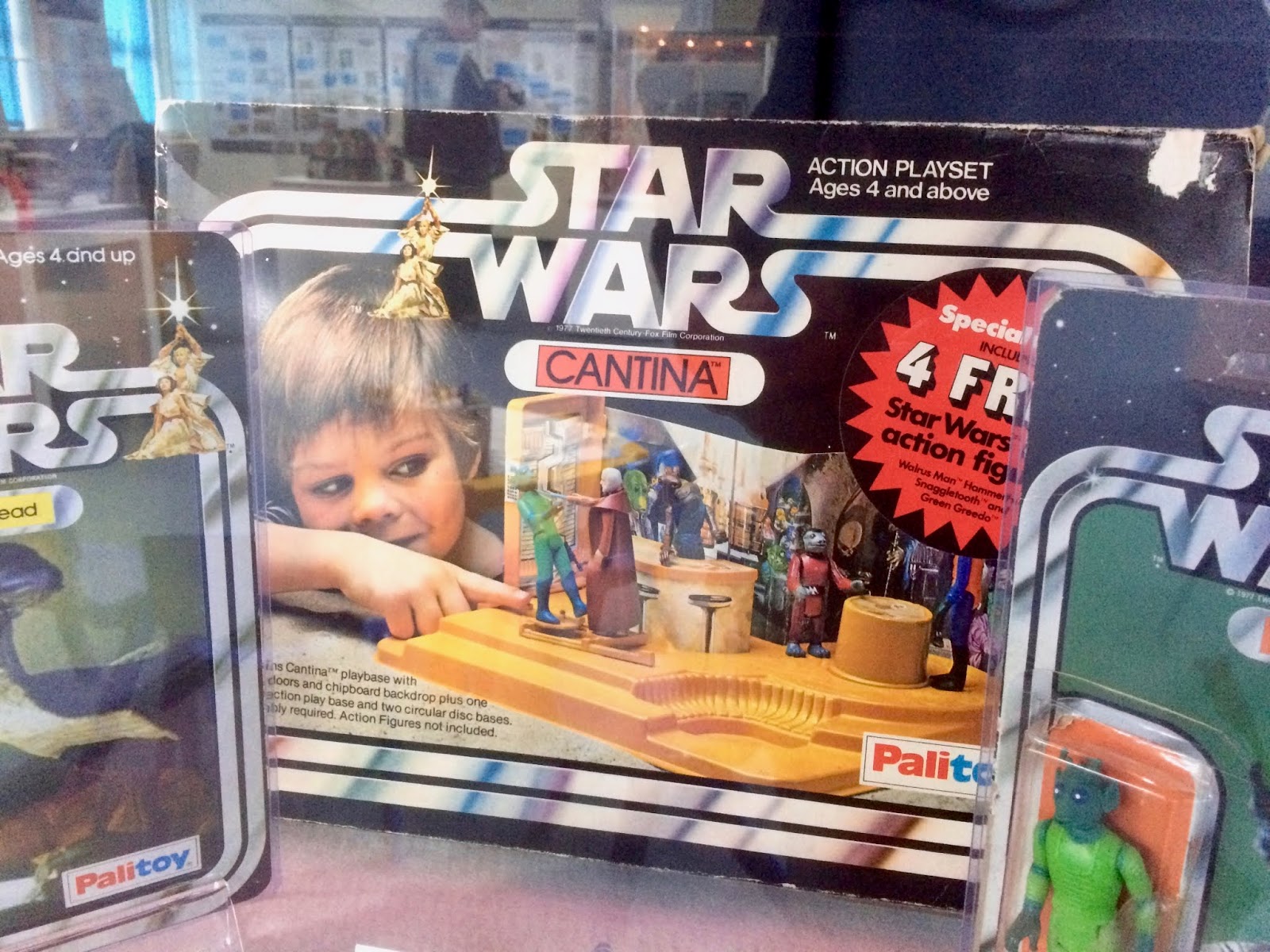
I am writing this blog after a visit to ‘May the Toys be With You’, an exhibition of Star Wars toys that was held at a conference centre in Coalville, Leicestershire on the original site of the Palitoy factory where the very toys were manufactured in the late 1970s and early ‘80s.


Incredibly, but perhaps not surprisingly, all the merchandise on show came from the personal collection of one Star Wars fan, Matt Fox. For anyone who was around when the first Star Wars films were released between 1977-83, or who had any of the toys, this exhibition would have been very nostalgic. For those who were local to the Palitoy factory off Jackson Street the sense of nostalgia would have been two-fold.


Palitoy was the home of Action Man, Tiny Tears and Pippa – the latter a diminutive fashion doll, and much cooler than Barbie in my opinion. Children from North West Leicestershire (like myself) lucky enough to have had relatives and family friends who worked at Palitoy were inundated with staff-discounted toys. There was also a factory outlet on Owen Street where you could buy these figures. Incidentally, the Rex Cinema, which was literally a light sabre’s length away from the factory, is where I saw the original Star Wars movies.


Film historian Peter Biskind argues that Star Wars proved young audiences would go to the cinema to see a film without big-name Hollywood stars. And that although merchandising tie-ins with films had already existed for several decades, Star Wars alerted the studios to a larger scale of merchandising through items such as T-shirts and action figures. Good or bad, this gave film studios from then onwards an incentive to replace complex characters with simple figures that could be turned into toys (Biskind, 1998: 341).


According to information given at the exhibition, approximately 300 million action figures of Luke Skywalker et al were sold between 1977 and 1985. Intriguingly, there is a legend that unsold leftover toys were sent to landfill and could be worth a fortune if they were dug up today. If only us kids had kept all our Star Wars figures – preferably still in their blister packs!


My last remaining Star Wars toys


Bibliography:

Biskind, Peter,1998, Easy Riders Raging Bulls, How the Sex ‘n’ Drugs ‘n’ Rock ‘n’ Roll Generation Saved Hollywood, London: Bloomsbury


Sunday, 30 September 2018

Carry On in Wellingborough


I was introduced to an interesting pub in Wellingborough, Northants. Highly regarded, the Coach and Horses has won numerous awards and judging by the interior decor (and the quality of the beer) it was easy to see why.


In creating the atmosphere of the pub, the owner must be something of a hoarder. Pump clips adorn almost every available space, alongside other breweriana.

What caught my eye, however, were the autographed photos of Carry On actors displayed on the walls.


Joan Sims, Jack Douglas, Kenneth Williams and Jim Dale


spot Hattie Jacques

Bernard Breslaw and Peter Butterworth snuggled amongst the pump clips

Although Babs, Hattie, Sid James, Kenneth Williams and Peter Butterworth et al were all present, believe me, this was no Whippet Inn.